

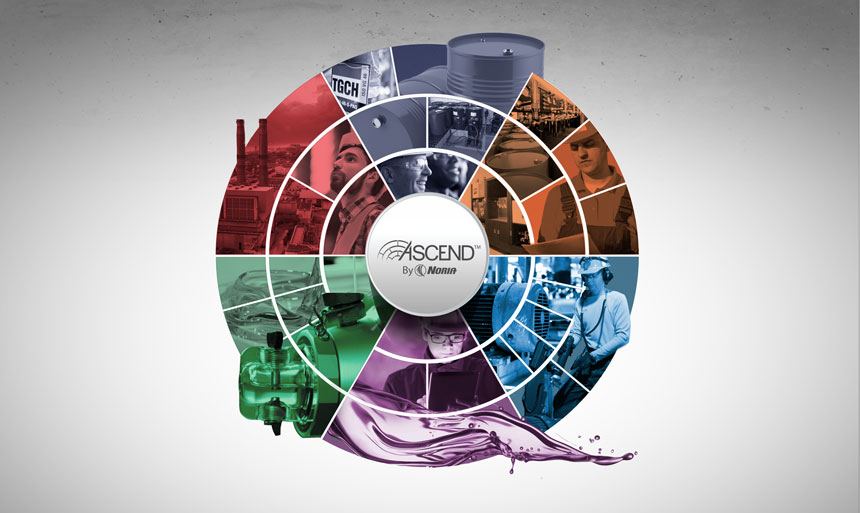
Many organizations aspire to achieve a state of lubrication excellence. What defines lubrication excellence was unclear until Noria gave rise to the Ascend™ method. It provides a powerful tool and metric to test, design, implement, and control the core of lubrication excellence.
Begin the journey toward lubrication excellence by comparing current practices with Noria’s Optimum Reference State (ORS). After identifying the gap, create a roadmap that directs resources, effort, and time to the highest-return initiatives.
Prioritization must be based on lubricant lifecycle logic and the impact of improvements on machine reliability and other organizational goals. Once the process begins, track progress, execute the transformation plan, identify deviations, and ensure the changes last.
Ascend™ represents a necessary evolution beyond the conventional radar chart, which long served as the standard for testing the lubrication process. It meets the business goals of many users who wish to create a lubrication program that ensures excellent plant dependability.
The Ascend™ technique draws on years of field experience, industry demands, established lubrication practices, and international asset management standards. Finally, our DNA of innovation and constant improvement drives execution.
Lubrication Lifecycle Stages
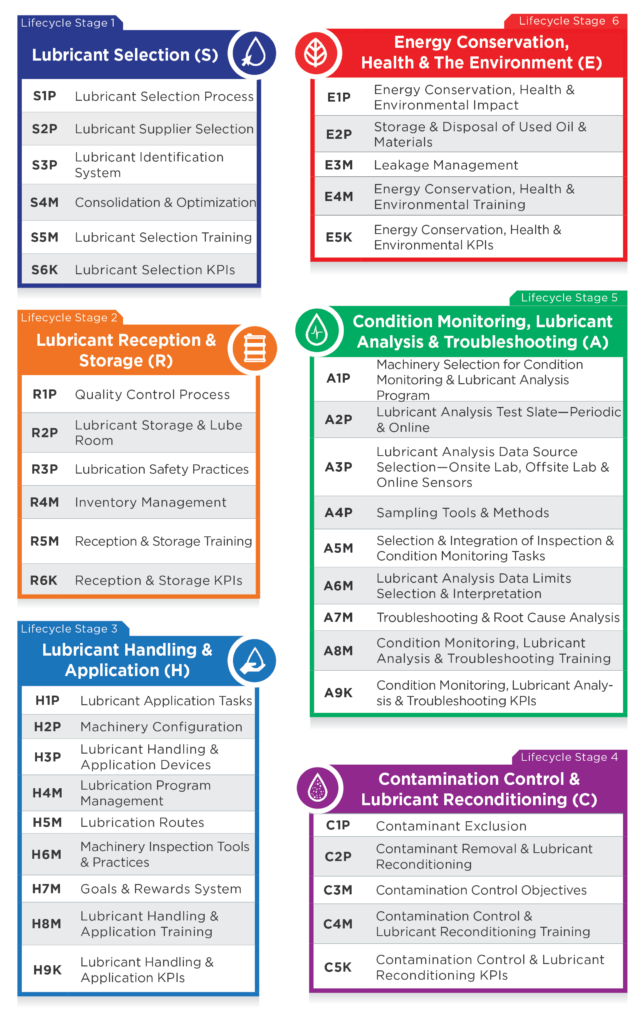
Ascend™ uses six lifecycle stages in chronological order: (1) Selection, (2) Reception, (3) Application, (4) Management, (5) analysis, and (6) disposal. It integrates the importance of these stages and their impact on lubrication excellence, machine reliability, and asset management.
By following the lubricant life cycle, users can link daily activities to fundamental business objectives. Moreover, they see how each stage contributes to the overall execution of proper lubrication principles.
Factors and Management Levels
The Ascend™ technique categorizes lubrication activities into 40 factors across the lubrication process lifecycle. However, not all factors carry equal weight in designing and implementing the lubrication plan. To clarify these differences, the factors are arranged into three levels.
Platform (P)
Platform factors form the program’s foundation, controlling risks, ensuring performance, and sustaining the program over time. Since these factors are tactical, implement them first.
Management and Training (M)
Management and training factors are activities that enable the needed resources, provide planning and scheduling, and deliver condition monitoring of lubricants and machines. This level provides staff education and skill development. Daily lubricating operations rely on and are supported by all platform factors.
Performance Indicators (K)
The Key Performance Indicators (KPIs) level enables evaluating the efficiency and efficacy of the actions in a lubrication program and later continual improvement.
For ease of identification, each factor has been allocated an alphanumeric code. The code consists of three digits: the first identifies the Lubrication Lifecycle Stage, the second the factor number within the stage, and the third the Management level.
ASCEND™ to Lubrication Excellence
The Ascend™ method applies Six Sigma’s DMAIC (Define, Measure, Analyze, Improve, Control) framework to assess the lubrication program’s maturity and guide its transformation from a defined starting point. The Optimum Reference State (ORS) compliance is evaluated through inspections, measurement, verification, and interviews.
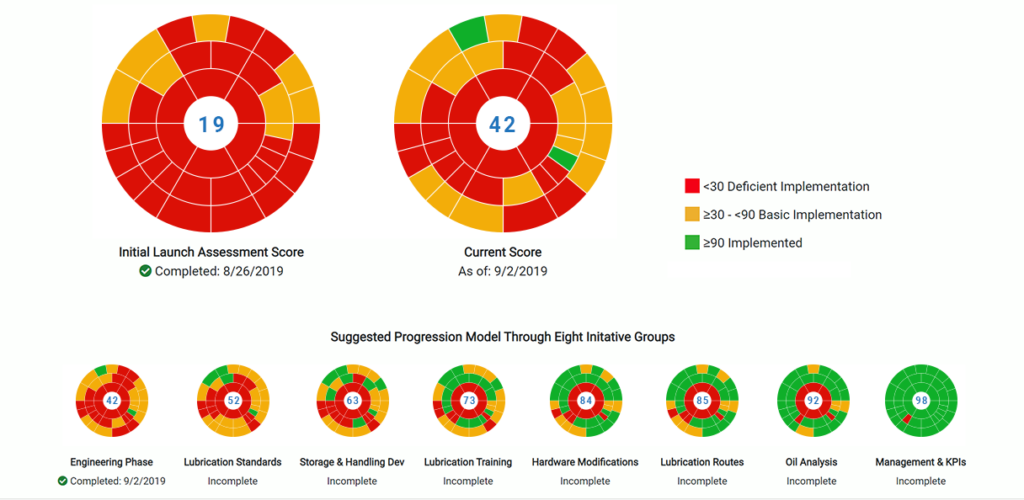
The Ascend™ method analyzes gaps between required ORS performance and current performance, guiding the implementation plan based on its impact on business objectives and reliability. It evaluates the maturity of each factor by assessing compliance during the assessment phase. Ascend™ also provides a list of specific improvements for meeting ORS requirements across all 40 lubrication process factors. It identifies the critical actions needed to implement the process with appropriate controls.
Ascend™ Global Compliance Level (ACL) is a comprehensive measure of the maturity of the lubrication program. The ACL is a complex calculation based on a proprietary mathematical formula that incorporates a Balanced Score Card (BSC) of the lubrication process and the maturity of each of the 40 factors. The active ACL value is shown in the Ascend™ Chart’s center.
Lubrication Program Development
Some organizations that recognize the importance of lubrication excellence may choose to develop a formal lubrication program and reap its benefits. With years of proven experience, we help the industry implement lubrication excellence through a comprehensive program. The program provides a detailed plan for all lubrication processes, from purchasing to specifying the re-grease volume for every plant bearing.
Source:
Trujillo, G., & Fitch, J. (n.d.). ASCEND™ to Lubrication Excellence. MachineryLubrication. Retrieved from https://www.machinerylubrication.com/Read/31946/ascend-lubrication-program-excellence